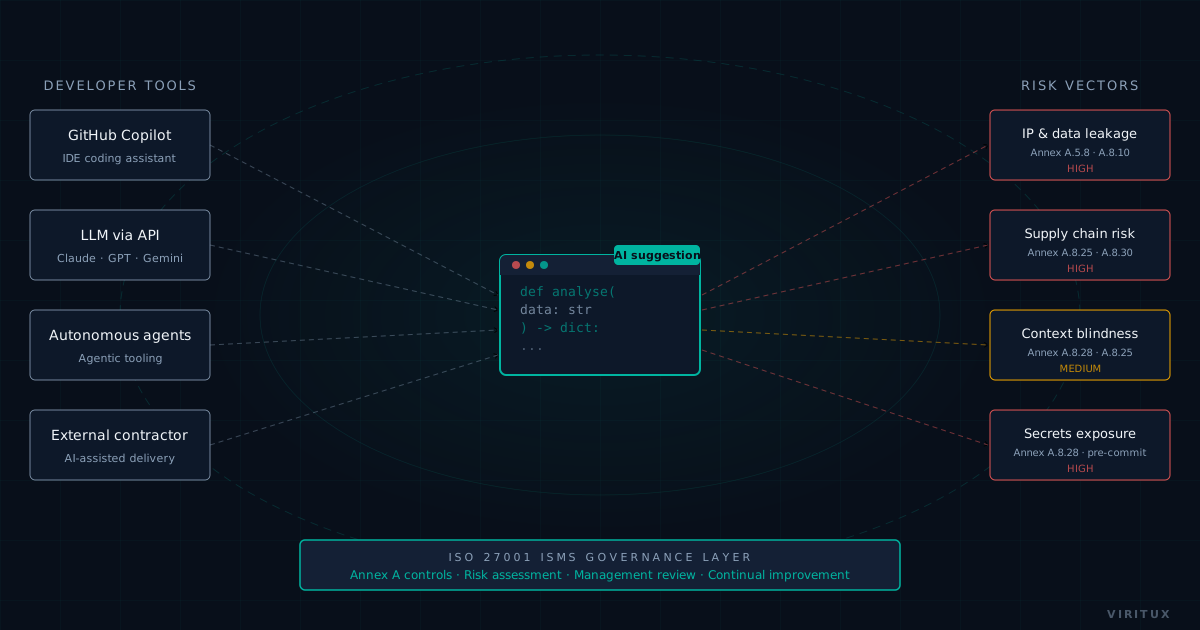
The integration of AI coding assistants into the software development lifecycle has moved from experimental to mainstream. Tools that suggest, complete, and increasingly generate entire code blocks are now part of everyday developer workflow. For organisations maintaining or working toward ISO 27001:2022 certification, that shift cannot happen in a governance vacuum.
The efficiency gains are real. So are the risks. Understanding how those risks map to your existing ISMS controls is the starting point for managing them proportionately.
The Core Risk Vectors
Moving past general data privacy concerns, the primary exposure areas for AI-assisted development are more specific.
Intellectual property and data leakage
Code snippets, proprietary algorithms, and internal system details transmitted to external AI models may be ingested into training pipelines. Hardcoded credentials or internal naming conventions sent via developer tooling telemetry represent a direct data leakage risk that sits squarely within your information classification and handling controls.
Code supply chain weaknesses
AI models generate code based on statistical patterns, not architectural understanding. That makes them prone to incorporating deprecated library versions, insecure function calls, and occasionally hallucinating package names that do not exist — creating an opening for dependency confusion or package planting attacks.
Context blindness
AI assistants lack awareness of your broader application architecture, access control model, or security boundaries. Code that is syntactically correct and passes unit tests may still undermine your security design in ways that standard review processes were not designed to catch at the speed AI-assisted development creates.
Mapping AI Governance to ISO 27001:2022 Controls
Governing AI developer tools does not require a separate compliance framework. The right approach is to integrate AI-specific requirements into your existing Annex A controls.
| Control | AI Governance Requirement |
|---|---|
| A.5.8 Information security in project management | Incorporate explicit AI risk parameters into project initiation. Ensure third-party LLM privacy terms align with your data classification requirements. |
| A.8.10 Information deletion | Validate vendor commitments on data retention. Confirm that code submitted via AI tooling is excluded from model training cycles. |
| A.8.25 Secure development lifecycle | Define approved AI tools within development policy. Require that all AI-generated code passes standard peer review and automated scanning before merge. |
| A.8.28 Secure coding | Enforce configuration standards that prevent AI tools from accessing or caching credentials, environment configurations, or sensitive internal logic. |
| A.8.30 Outsourced development | Update contractor agreements to require disclosure and logging of any AI or LLM tooling used during contract delivery. |
Operational Controls Worth Implementing
Formalise an AI tool registry
Shadow AI is the new shadow IT. Your A.8.25 documentation should explicitly distinguish approved enterprise AI platforms from consumer-grade interfaces. Consumer accounts that use telemetry data for public model training should be blocked at the corporate DNS or endpoint level, not left to individual developer discretion.
Implement pre-commit guardrails
When development velocity increases, the window for catching problems narrows. Pre-commit hooks using entropy scanners and pattern matching can prevent secrets, API tokens, and internal identifiers from reaching AI contexts or telemetry relays before a commit is made. This shifts detection left in a way that complements rather than replaces your existing pipeline controls.
Recalibrate your SAST rule sets
AI-generated code produces patterns that standard static analysis tools were not originally designed to detect. Common issues include weak cryptographic initialisation, missing input sanitisation in rapidly generated boilerplate, and logical access control gaps that pass syntactic checks. Security teams should review and extend SAST configurations to account for the characteristic failure modes of AI-generated output.
A Note on Risk Assessment
When modelling these risks, AI tool deployment directly expands your attack surface — the Annex A controls above address the exposure. It also increases the rate at which complex code can be pushed by developers who may not have the security background to evaluate what the AI has generated. That combination means the risk is not just in the tool itself but in the governance gap between AI-assisted velocity and your existing review and assurance processes.
The Governance Principle
Treating an AI coding assistant as an untrusted third-party contractor within your ISMS is a useful working model. You would not allow an external contractor to push code without review, access credentials without logging, or use unapproved tools without disclosure. The same standards apply here.
The goal is not to prevent teams from using tools that genuinely improve productivity. It is to ensure that the governance framework keeps pace with the tools, so efficiency gains do not accumulate as unmanaged risk inside your ISMS.