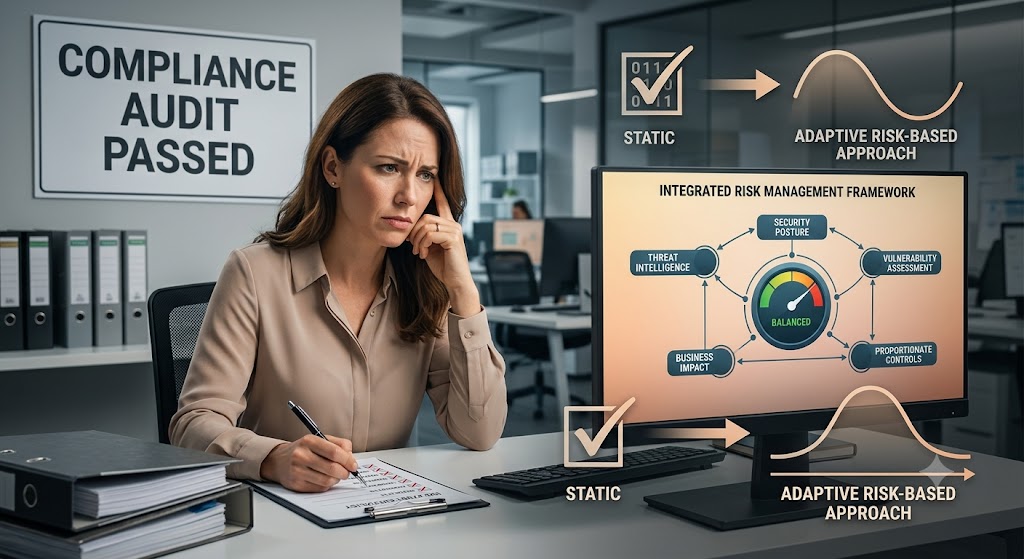
In information security, certifications like ISO 27001 are often viewed as the gold standard. Achieving certification reassures clients, stakeholders, and partners that an organisation takes security seriously. However, a common trap lies in treating ISO 27001 — or any compliance framework — as the ultimate finish line.
When security is reduced to checkbox compliance, organisations risk building a rigid, expensive, and ultimately ineffective security posture.
The Trap of Checklist Compliance
ISO 27001 provides an excellent foundational framework for an Information Security Management System. It ensures that policies, procedures, and controls are in place. The problem arises when organisations implement controls simply to satisfy an auditor, rather than to mitigate actual business risk.
Consider an organisation that enforces a 90-day password rotation policy and complex password requirements across the board because it appears in Annex A. In doing so, they may ignore modern authentication approaches — such as passkeys or MFA-heavy, non-expiring passwords — that genuinely improve both usability and security. They tick the box, but users experience fatigue and resort to workarounds that inadvertently increase risk.
The certificate is obtained. The risk is not reduced.
What a Risk-Proportionate Security Posture Actually Means
A risk-proportionate security posture means that your security investments, controls, and operational focus are directly aligned with the actual probability and impact of threats relevant to your organisation.
Instead of applying uniform controls across every asset regardless of sensitivity, a risk-proportionate approach asks:
- What are the most critical assets — the systems and data the business genuinely depends on?
- What are the most likely threat vectors targeting those assets in your sector and operating context?
- What is the financial and operational impact if those assets are compromised?
By working through those questions honestly, organisations can allocate resources efficiently — applying robust, layered controls where the risk is high, while using proportionate, lighter controls for lower-risk environments. This is not a reduction in rigour. It is a redirection of effort toward the areas where it actually matters.
Moving Beyond Checkbox Compliance
Shift from “does it exist?” to “is it effective?”
Auditors check for the existence of a document or a process. Security teams need to check for effectiveness. A disaster recovery plan that has never been tested is not a control; it is a document. Running tabletop exercises, performing periodic validation, and measuring detection and response times turns paper processes into operational reality.
Incorporate threat modelling
Threat modelling involves understanding where your data flows, who has access to what, and where the genuine vulnerabilities sit — specific to your architecture, not generic to your sector. This proactive, contextual approach identifies risks that a static checklist will never surface, and it feeds directly into better risk assessment and treatment decisions within your ISMS.
Connect security to business objectives
Controls that leadership does not understand tend not to be followed. When security decisions are explained in terms of protecting revenue, reputation, or regulatory standing, the rationale becomes visible. Compliance naturally follows when people understand why a control exists, rather than experiencing it as an administrative imposition.
Where ISO 27001 Fits in This Picture
ISO 27001 is a management system standard, not a prescriptive technical specification. Its strength is precisely that it requires you to identify your specific risks and design proportionate controls in response. The framework supports risk-proportionate security; the problem arises when organisations treat the control list as a destination rather than a structure for ongoing risk management.
Used well, ISO 27001 provides the governance scaffolding — risk assessment methodology, management review, internal audit, continual improvement — that keeps a security posture calibrated to actual risk over time. That ongoing calibration is what separates a working ISMS from a document that gathers dust between certification visits.
The Practical Point
Compliance frameworks are critical tools, but they are the floor, not the ceiling. Building a risk-proportionate security posture requires treating risk management as a continuous operational discipline rather than a periodic compliance exercise. Organisations that make that shift protect what matters most, adapt more readily to a changing threat landscape, and find that genuine security and audit readiness tend to arrive together.