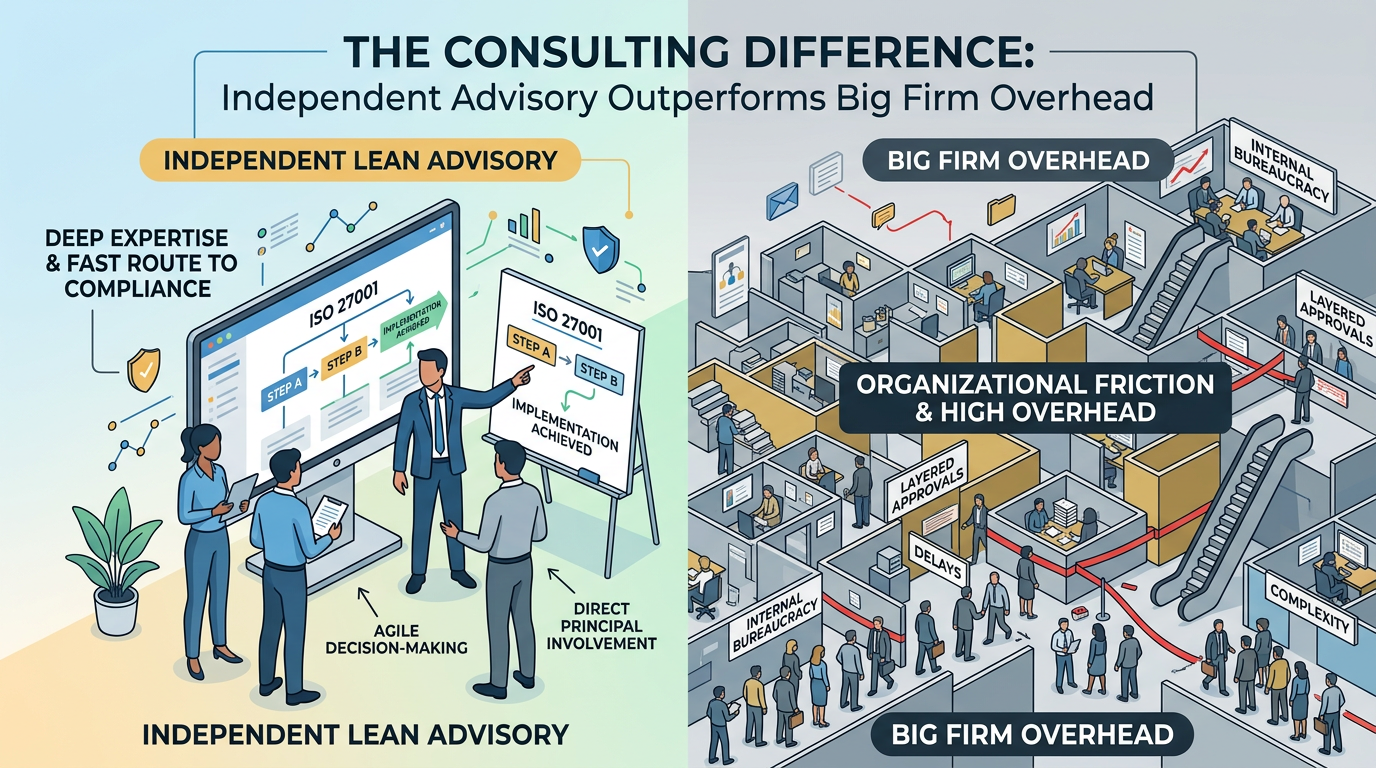
When a board decides to pursue ISO 27001 certification, the next question is usually: who do we bring in to help? The instinct in many organisations is to reach for a recognisable brand. A global consulting firm carries a certain comfort, a sense that the risk is shared. But that comfort often comes at a steep price, and not just financially.
The institutional machinery of a large firm tends to slow things down. Proposals go through multiple sign-off layers. Engagement managers rotate. The consultant who pitched the work is rarely the one who shows up on day one. For something as hands-on as an ISO 27001 implementation, that model creates friction right from the start.
What Big Firm Structure Actually Costs You
Large consulting practices are structured around scale. They deploy teams of analysts and associates, each billing at rates designed to cover the firm’s overheads, internal training programmes, real estate, and partner profit margins. That overhead does not disappear just because your project is relatively contained.
The result is a common pattern: junior consultants do the bulk of the delivery work, senior figures appear periodically to review outputs, and knowledge transfer between team members adds latency to every decision. For an ISO 27001 programme, where context and continuity matter enormously, this creates a real cost in time and quality.
It also means you frequently end up educating your own advisers. If the person attending your weekly working group is six months out of university and working from a methodology template, the practical value they add is limited. You still pay for their learning curve.
What Principal-Led Delivery Actually Means
The phrase gets used loosely, so it is worth being precise. A principal-led engagement means the experienced consultant who scopes and prices the work is the same person actively delivering it, week in and week out. There is no handoff to a delivery team. The person who understands your risk landscape, your IT architecture, and your organisation’s culture is the person writing the risk treatment plan and sitting in the evidence review.
That continuity has a direct effect on pace. Decisions that might take days to filter through a large team can be made in a single call. Scope questions get answered by someone with full context rather than escalated upwards. Drafts do not bounce between analysts before reaching the person capable of finalising them.
For ISO 27001 specifically, this matters because the standard demands a thorough understanding of your organisation’s context, its assets, its threat landscape, and the way it actually operates, not the way an org chart suggests it operates. That understanding cannot be delegated to someone who has never spoken to your IT lead or your legal team.
Speed Without Cutting Corners
Faster does not mean rushed. It means eliminating the waste that large engagements accumulate: duplicated review cycles, status reports written for an internal audience rather than your benefit, procurement delays, and the general overhead of managing a team rather than doing the work.
Lean project methodologies focus precisely on this point. The goal is to strip away activity that does not contribute to the outcome. In an ISO 27001 context, the outcome is a robust, auditable information security management system that reflects genuine organisational risk, not a stack of policy documents assembled from a shared template library.
Principal-led consultancies naturally operate on leaner lines. Without internal billing pressure to justify large teams, the engagement is scoped to what is actually required. Outputs are proportionate to the organisation’s size and risk profile rather than inflated to justify fee levels.
The Knowledge Retention Problem
There is another dimension that rarely appears in proposal documents: what happens after the engagement ends. With large firms, institutional knowledge tends to leave with the engagement. The methodology is proprietary. The templates belong to the firm. The consultant moves to the next client.
Independent advisers working in a principal-led model have a different incentive. Their reputation depends entirely on your outcome. They are not protected by a brand name if the certification audit goes badly. That alignment of interest tends to produce better knowledge transfer, clearer documentation, and a genuine investment in your team’s ability to maintain the management system after the consultant is gone.
For organisations in regulated sectors, including financial services and central government, this matters beyond the initial certification. ISO 27001 is a continuous process. The ISMS needs to be maintained, reviewed, and improved. If your team cannot operate it independently after the implementation, the long-term compliance position is weak regardless of what the certificate says.
What to Actually Look For When Choosing a Consultant
Reputation and brand recognition are a starting point, not a conclusion. When evaluating an ISO 27001 adviser, the questions worth asking include:
- Who will actually be doing the work, and what is their direct implementation experience?
- Can they show evidence of certifications they have taken organisations through, not just assessments they have written?
- How do they handle scope changes or unexpected complexity mid-engagement?
- What does the handover look like, and what documentation will your team own at the end?
- Have they worked with organisations of similar size, regulatory context, and technical maturity?
A large firm can struggle to answer some of these honestly, because the honest answer involves admitting that the senior person in the room will not be the one building your asset register or running your risk workshops. An independent principal consultant either answers them directly or does not win the work. That accountability shapes every aspect of delivery.
Proportionate Advice for Proportionate Organisations
There is no single right model for every engagement. Large organisations with highly complex, multi-jurisdictional programmes may genuinely need the staffing depth that a major consultancy provides. But for the majority of organisations pursuing ISO 27001, including SMEs, growth-stage technology companies, and public sector bodies working within budget constraints, the better outcome comes from working directly with experienced practitioners rather than through layers of firm infrastructure.
The standard itself is not simple, but the path to certification does not need to be made complicated by the engagement model. Clear scope, experienced delivery, genuine continuity, and a consultant who is as invested in your outcome as you are: that is the actual fast track.