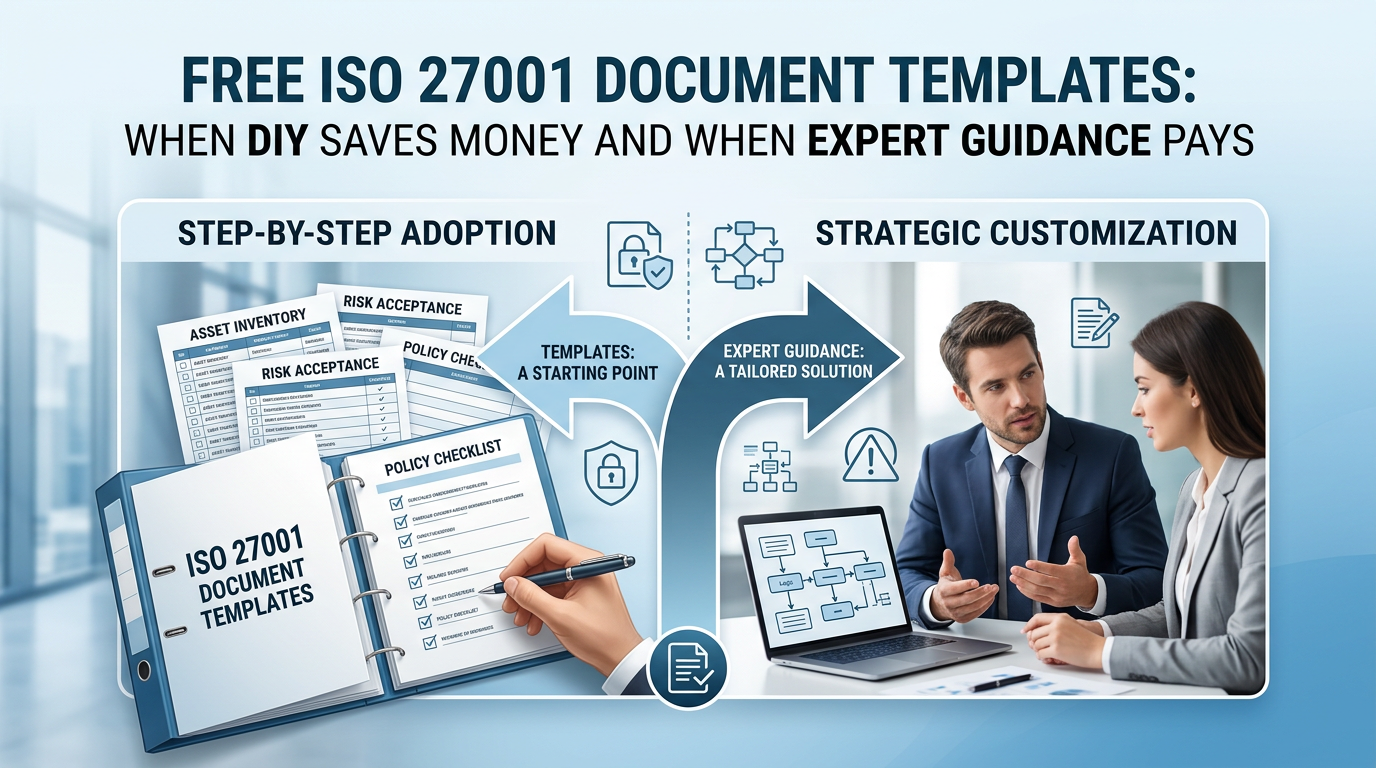
The internet is full of free ISO 27001 document templates. Policy frameworks, risk registers, statement of applicability spreadsheets, asset inventories, the lot. For an organisation just starting its ISMS journey, downloading a ready-made pack feels like a sensible shortcut. Sometimes it genuinely is. Other times, it stores up serious problems for the certification audit.
The honest answer is that templates are a tool, not a solution. Whether they serve you well depends entirely on what you are using them for and how much thought goes into adapting them to your actual organisation.
What Templates Actually Do Well
ISO 27001 certification requires a defined set of documents. Auditors expect to see them. Templates help you understand what structure those documents should follow and what clauses they need to address. For relatively generic policies, a well-written template covers most of the ground.
The documents where templates add the most value tend to be the procedural ones: formats that need a consistent layout more than bespoke content. Good candidates include:
- Information security policy (high-level statement of intent)
- Acceptable use policy
- Access control policy
- Incident response procedure
- Business continuity plan structure
- Internal audit schedule templates
For an SME with limited internal resource, starting with a solid template for these documents is entirely reasonable. It stops the blank-page paralysis and gives you a compliance-informed skeleton to build on.
The Documents That Almost Always Need Custom Work
Here is where organisations consistently get caught out. Some ISO 27001 documents cannot be meaningfully completed by filling in a few fields. They require genuine analysis of your specific environment, and auditors can tell the difference immediately.
The risk assessment and risk treatment plan are the most common problem area. A downloaded risk register gives you columns and categories, but the content must reflect your actual assets, threat landscape, existing controls, and risk appetite. An auditor reviewing a risk register that lists generic IT threats with no connection to your sector, your architecture, or your suppliers will flag it. It is not just a presentation problem; it usually means the underlying analysis was not done.
Other documents that require substantive custom design include:
- Statement of Applicability (SoA) — This is a critical document. It records which of the 93 controls in Annex A you have selected, which you have excluded, and your justification for both. A template gives you the table structure. The decisions inside it must come from your risk treatment process, not a default list.
- Context of the organisation — Clause 4 of ISO 27001 requires you to identify internal and external issues, interested parties, and the scope of your ISMS. This is organisation-specific by definition.
- Supplier and third-party security policies — These need to reflect your actual supply chain, your contractual obligations, and your sector’s specific requirements.
- Business continuity and disaster recovery plans — Recovery time objectives, recovery point objectives, critical system dependencies: none of that can come from a template.
The Template Trap: Compliance Theatre
There is a pattern that experienced auditors recognise instantly. An organisation downloads a full ISO 27001 toolkit, inserts their company name at the top of each document, and submits it for certification. The documents look complete. The document register is full. But the content does not match the organisation at all.
This is sometimes called compliance theatre: the appearance of a management system without the substance. The risk here is not just a failed audit. It is that your ISMS does not actually protect you. If your incident response procedure describes a team structure that does not exist, or your risk register does not reflect the cloud services you actually run, the documentation is working against you.
Certification bodies have tightened scrutiny on exactly this point. Expect auditors to ask specific questions about how your documented processes connect to operational reality.
A Practical Decision Framework
A simple way to decide how much customisation a document needs is to ask two questions. First, could any organisation in your sector complete this document the same way? Second, does the document require decisions that only someone with knowledge of your specific systems, risks, or structure could make?
If the answer to the first question is yes and the second is no, a template with light editing will probably suffice. If the reverse is true, you need more than a template.
It also helps to think about the document’s role in the audit. Documents that auditors actively probe, such as the risk assessment methodology, the SoA, and management review records, deserve proportionally more investment in getting right.
Where Expert Guidance Changes the Outcome
For organisations without an in-house ISO 27001 specialist, the genuine value of external advisory is not in writing policies from scratch. It is in the judgement calls: which controls apply to your environment, where your risk treatment decisions are defensible, how to scope your ISMS to avoid over-committing, and how to connect your documentation to what actually happens operationally.
A consultant who has been through dozens of certification audits knows which gaps auditors focus on, what weak justifications look like in an SoA, and how to ensure your risk register tells a coherent story. That knowledge is difficult to replicate by reading the standard and downloading a template pack, even a good one.
The economics are also worth considering plainly. A failed Stage 2 audit costs recertification fees, remediation time, and often a significant delay to a contract or tender that was waiting on certification. Spending on proportionate expert input upfront is usually cheaper than fixing avoidable gaps after the fact.
Getting the Balance Right
Templates and expert guidance are not an either/or choice. The most efficient path for most organisations is to use templates for the structural and procedural documents where generic content is genuinely fit for purpose, while investing time and expertise in the documents that require real analysis.
Start by identifying which Annex A controls are in scope for you. Use a template to understand the format of each required document. Then be honest about which ones you can complete accurately with internal knowledge alone and which ones carry real audit risk if they are generic. That honest assessment is itself a useful early step in the ISMS process.
If you are unsure where your documentation stands or want a straightforward review before a certification audit, that is exactly the kind of focused advisory engagement that does not require a full consulting retainer.